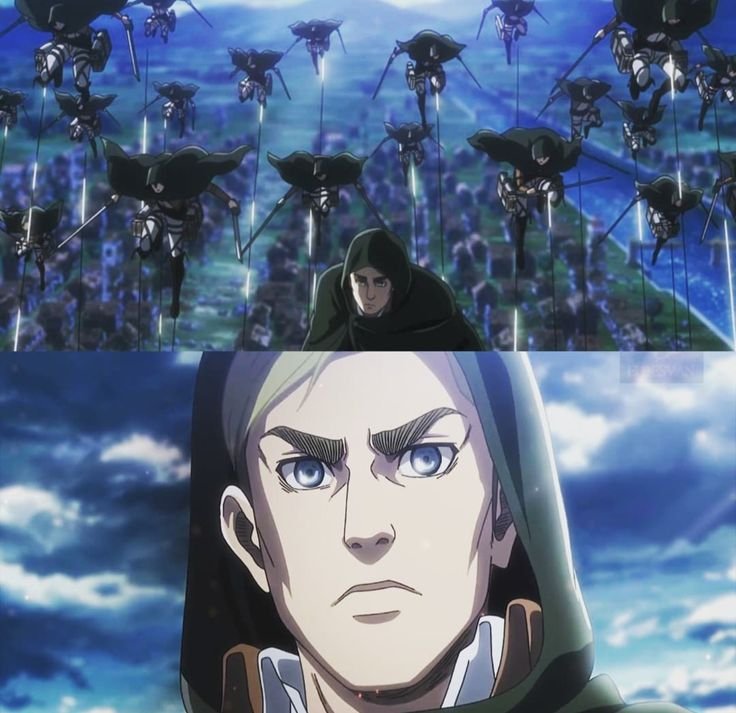
Imagine a chessboard where the pieces are nations, the stakes are humanity's future, and the players are two of fiction's most legendary strategists: Canute, the stoic Viking king from Vinland Saga, and Erwin Smith, the relentless commander of the Survey Corps from Attack on Titan. On the surface, they hail from vastly different worlds – one a historical epic of conquest and peace, the other a desperate struggle against existential horror. Yet, both stand as paragons of leadership, individuals whose sheer will and strategic brilliance carved their names into history.
But what happens when these two titans of command are pitted against each other? This isn't a simple brawl; it’s a profound examination of leadership, strategy, ideology, and the very nature of victory. Welcome to our deep dive into the ultimate commander clash, a comprehensive hub designed to unravel every facet of this compelling hypothetical battle.
The Art of Command: Leading From the Front, or From Within?
At the heart of any great leader is their ability to inspire, motivate, and direct their forces. Canute and Erwin, despite their shared genius, employ starkly different methodologies to command loyalty and achieve their objectives. Canute, initially a timid prince, transforms into a serene, almost messianic king, leading with a quiet, unwavering vision of a peaceful world, inspiring through conviction and the promise of a future free from conflict. His leadership is often perceived as calm, deliberate, and deeply intellectual, focused on the long game of political and societal transformation.
Erwin Smith, conversely, is a force of nature, a charismatic orator who can galvanize his soldiers with a single speech, urging them to dedicate their hearts to humanity's survival. He leads by example, taking calculated risks and demanding ultimate sacrifice, driven by an unyielding quest for truth. His methods are often more immediate, focused on overcoming overwhelming odds on the battlefield through sheer courage and tactical audacity. To truly grasp the nuances of their influence, dive into . Understanding these distinct approaches is crucial to predicting how their forces might respond in a shared scenario.
Battlefields and Boardrooms: A Clash of Strategic Minds
When it comes to strategy, both Canute and Erwin are maestros, but their expertise manifests in different arenas. Erwin Smith is renowned for his tactical genius on the battlefield. Faced with monstrous Titans and seemingly insurmountable odds, he routinely devises ingenious, often terrifyingly costly, strategies to secure victories for humanity. His plans are characterized by their boldness, adaptability, and a willingness to exploit any opening, no matter how small or dangerous. From the formation of the long-distance scouting formation to the final charge at Shiganshina, Erwin’s name is synonymous with calculated, high-stakes tactical brilliance.
Canute, on the other hand, operates on a grander, more political chessboard. While he can command armies, his true mastery lies in long-term geopolitical strategy, diplomacy, and the manipulation of power structures. His vision extends beyond mere battles; he seeks to reshape societies, quell rebellions through political maneuvering, and establish lasting peace through radical societal change. His "paradise on Earth" is a strategic goal achieved not just by swords, but by words, alliances, and the dismantling of old orders. For a detailed breakdown of Erwin’s battlefield prowess, we recommend exploring . Meanwhile, to appreciate Canute's broader impact and long-game approach, you'll want to read about .
Beyond the Battlefield: The Weight of Motivation and Ideals
What truly drives these commanders? Their motivations are as distinct as their worlds, yet equally powerful in shaping their decisions and actions. Erwin Smith is fueled by an insatiable thirst for truth – the truth about the Titans, the world outside the walls, and the history suppressed by his government. This quest becomes his ultimate purpose, justifying every sacrifice and pushing him to the brink of despair, yet never breaking his resolve. His dedication to humanity's survival is interwoven with his desire to uncover secrets.
Canute’s journey is one from personal suffering to a grand, almost spiritual vision of a world without war or slavery. He aims to create a "paradise on Earth," a place where people can live without conflict. This ideal informs every strategic move, every political decision, transforming him from a reluctant prince into a king willing to pursue peace through any means necessary, even if those means are violent in the short term. The core difference in their ultimate "why" fundamentally shapes their leadership. To fully appreciate the ideological chasm and shared drive between them, delve into .
The Tools of War: Assessing Physicality and Resources
While both Canute and Erwin are primarily commanders, not frontline fighters, their physical presence and the resources they command play a role in their overall effectiveness. Erwin Smith, though not a combat specialist like Levi, possesses an imposing presence, a towering figure whose physical demeanor commands attention and respect. He has demonstrated considerable resilience and a willingness to put his own body on the line. The Survey Corps, his primary force, is small but elite, trained for speed, agility, and desperate battles against overwhelming odds, though perpetually resource-scarce.
Canute, initially perceived as physically weak, grows into a figure of quiet authority. He is not a warrior in the Viking sense, but his transformation imbues him with a formidable, almost unshakeable composure that can be as intimidating as any blade. His resources are vast: the armies of a nascent empire, the political machinery of kingdoms, and the economic power to sustain long-term ambitions. Understanding the inherent strengths and limitations of their physical attributes and the armies they command is essential for a complete picture. Explore for a more detailed look.
Enduring Impact: Measuring Their Legacy
Beyond their immediate victories and defeats, how do Canute and Erwin Smith shape the worlds they inhabit and the people they lead? Both leave an indelible mark, their legacies echoing long after their direct actions. Erwin’s unwavering resolve and the sacrifices he inspired were instrumental in humanity’s fight against the Titans, pushing the boundaries of what his people believed was possible. He became a symbol of humanity’s defiance, his memory serving as a powerful catalyst for those who followed.
Canute's legacy is perhaps more foundational, aimed at reshaping the very fabric of society. His pursuit of Vinland, and the ideals of peace and freedom, sets a long-term precedent for governance and human relations. His ambition wasn't just to win battles, but to change the very concept of warfare and societal structure. His impact is measured not just in victories, but in the slow, difficult process of societal evolution. To understand how their actions reverberated through their respective narratives, consider .
The Ultimate Confrontation: Who Wins a Battlefield Showdown?
So, who would win? A definitive answer is elusive because the victory depends entirely on the parameters of the hypothetical conflict. Is it a direct battlefield engagement between their forces? Is it a long-term political struggle for influence? Is it a test of survival in an unknown land? If it’s a desperate tactical engagement against an unforeseen enemy, Erwin’s immediate brilliance and willingness to sacrifice might give him an edge. His ability to improvise under extreme pressure is unparalleled.
However, if it's a protracted conflict involving diplomacy, resource management, and the long-term morale of diverse populations, Canute’s strategic patience and political acumen might prove superior. His ability to understand and manipulate societal currents could slowly undermine any opposing force. Ultimately, this isn’t just about who has the better army or the sharper mind; it’s about whose vision, whose approach, and whose sheer force of will is best suited to the specific challenge. For a detailed hypothetical scenario and a breakdown of potential outcomes, don't miss .
The clash between Canute and Erwin Smith is more than just a fight; it's a mirror reflecting different facets of what it means to lead, to sacrifice, and to envision a better future. Their comparison offers profound insights into the complex art of command and the enduring power of human will. What lessons can we, the readers, draw from their contrasting yet equally impactful journeys? Perhaps the greatest victory lies in the realization that even in vastly different worlds, the spirit of extraordinary leadership remains universally compelling.